
Alex Eala's head-to-head records show how her meetings with individual opponents have unfolded. Her current singles ranking is No. 15, but a ranking position does not describe a particular match-up. Start with the table and its date, then use the dated match accounts below for context: the surface, the stage of the tournament and whether a match was completed or ended in retirement.
Alex Eala head-to-head records at a glance
The table covers singles records from the WTA match feed, including qualifying, WTA 125 and ITF matches in its records; it is not limited to WTA Tour main draws. Scores are shown from Eala's side. Retirements count towards wins and losses; walkovers do not. For example, Paula Badosa withdrew before their scheduled Miami 2025 match, so that walkover added neither a win nor a loss. Multi-sport events are outside this table's scope. Compare records only when the coverage and cutoff date match.
| Opponent | H2H (Eala first) | Meetings | Latest meeting |
|---|---|---|---|
| Iga Swiatek (POL) | 2-1 | 3 | 2026 Wimbledon R32 – Eala 7-6(9), 6-2 |
| Jelena Ostapenko (LAT) | 2-1 | 3 | 2026 Upper Austria Ladies Linz R16 – Ostapenko 4-6, 5-7 |
| Madison Keys (USA) | 1-0 | 1 | 2025 Miami Open R32 – Eala 6-4, 6-2 |
| Jessica Pegula (USA) | 1-1 | 2 | 2026 Mubadala DC Open F – Eala 4-6, 6-4, 6-0 |
| Maya Joint (AUS) | 1-1 | 2 | 2026 Wimbledon R64 – Eala 3-6, 6-2, 6-0 |
| Coco Gauff (USA) | 1-1 | 2 | 2026 BNP Paribas Open R32 – Eala 6-2, 2-0, ret. |
| Elena Rybakina (KAZ) | 1-1 | 2 | 2026 VANDA Pharmaceuticals Berlin Tennis Open R16 – Eala 7-5, 6-4 |
| Elina Svitolina (UKR) | 2-0 | 2 | 2026 Mubadala DC Open QF – Eala 6-3, 6-4 |
| Jasmine Paolini (ITA) | 1-1 | 2 | 2026 Wimbledon R16 – Paolini 4-6, 6-4, 3-6 |
| Naomi Osaka (JPN) | 1-0 | 1 | 2026 Mubadala DC Open SF – Eala 6-4, 6-2 |
| Leylah Fernandez (CAN) | 1-1 | 2 | 2026 Mubadala DC Open R16 – Eala 6-2, 7-6(1) |
| Qinwen Zheng (CHN) | 1-0 | 1 | 2026 Mubadala DC Open R32 – Eala 4-6, 6-4, 6-1 |
| Clara Tauson (DEN) | 1-0 | 1 | 2025 US Open R128 – Eala 6-3, 2-6, 7-6(11) |
| Iva Jovic (USA) | 0-3 | 3 | 2026 US Open R32 – Jovic 5-7, 6-3, 5-7 |
| Linda Noskova (CZE) | 0-2 | 2 | 2026 VANDA Pharmaceuticals Berlin Tennis Open SF – Noskova 2-6, 4-6 |
| Karolina Muchova (CZE) | 0-1 | 1 | 2026 Miami Open R16 – Muchova 0-6, 2-6 |
| Belinda Bencic (SUI) | 0-1 | 1 | 2026 National Bank Open R16 – Bencic 4-6, 0-6 |
| Amanda Anisimova (USA) | 0-1 | 1 | 2026 Cincinnati Open R32 – Anisimova 6-4, 4-6, 2-6 |
| Barbora Krejcikova (CZE) | 0-1 | 1 | 2025 Wimbledon R128 – Krejcikova 6-3, 2-6, 1-6 |
| Ekaterina Alexandrova (RUS) | 0-1 | 1 | 2026 Mubadala Abu Dhabi Open QF – Alexandrova 3-6, 3-6 |
| Victoria Mboko (CAN) | 0-1 | 1 | 2025 Prudential Hong Kong Tennis Open R16 – Mboko 6-3, 3-6, 4-6 |
| Paula Badosa (ESP) | 0-0 | 1 | 2025 Miami Open R16 – Eala walkover |
| Diana Shnaider (RUS) | 0-2 | 2 | 2026 Pan Pacific Open (Tokyo) Quarterfinal – Shnaider 6-2, 6-7(5), 4-6 |
WTA-sanctioned singles matches, as of 8 Nov 2026. Score from Eala's side.
The match accounts and record labels below cover the history through 8 October 2026. For records after that cutoff, use the table above and its stated date.
Alex Eala vs Swiatek: 2-1 against a top-three rival
Swiatek is the rival that made Eala's name. At the Miami Open 2025, as a wildcard ranked No. 140, she beat the then world No. 2 in the quarterfinals 6-2, 7-5. Swiatek levelled a month later in the second round in Madrid, coming back to win 4-6, 6-4, 6-2 on clay.
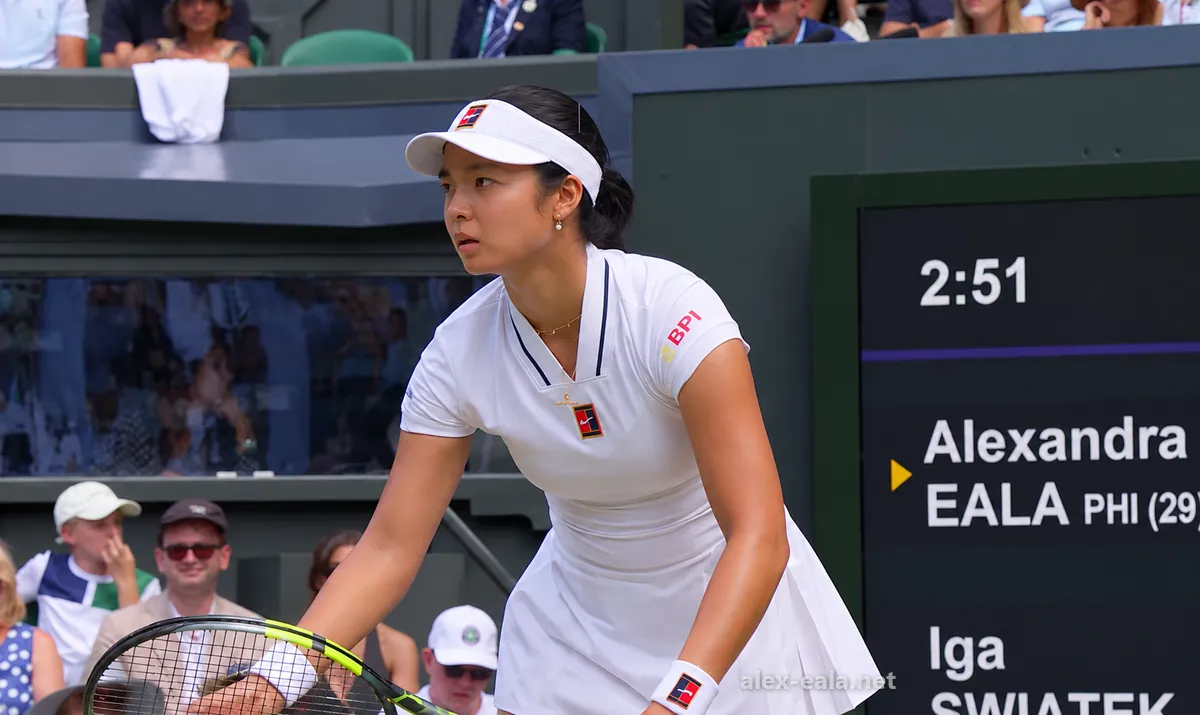
The third meeting came in the third round of Wimbledon 2026, against Swiatek as defending champion and world No. 3. Eala saved two set points in the first-set tiebreak, won it 11-9 and closed out a 7-6(9), 6-2 victory. Both of her wins came against Swiatek ranked inside the top three.
Alex Eala vs Pegula, Gauff and Keys
Jessica Pegula: 1-1
The two met in the Miami 2025 semifinal, where Pegula, then No. 4, won 7-6(3), 5-7, 6-3. Their second match was the Washington final on 2–3 August 2026. Pegula, the top seed and No. 3, won the first set 6-4 and still led by a set when rain stopped play. On the resumption the next day Eala won 4-6, 6-4, 6-0, taking the last nine games for her first WTA Tour title.
Coco Gauff: 1-1
Gauff, ranked No. 4, beat Eala 6-0, 6-2 in the Dubai quarterfinal in February 2026. Less than three weeks later they met again in the third round at Indian Wells, where Gauff retired with Eala leading 6-2, 2-0. The two have also played together: they partnered in doubles at Rome 2025 and reached the quarterfinals.
Madison Keys: 1-0
Their only meeting was in the third round of Miami 2025. Eala beat Keys, the world No. 5 and reigning Australian Open champion, 6-4, 6-2 — one of three wins over Grand Slam champions on that run.
Alex Eala vs Jovic and Noskova: the toughest match-ups
Iva Jovic: 0-3
All three meetings came in 2026, and all on big stages. Jovic, then No. 17, won the first round at Roland Garros 6-4, 6-2. On grass at Queen's she won 6-2, 6-2 in the second round. The closest of the three was the third round of the US Open on 5 September: Eala led 4-2 in the deciding set, but Jovic won 7-5, 3-6, 7-5 after about three hours.
Linda Noskova: 0-2
Noskova stopped Eala twice in 2026 at the stage where a big result was within reach: 6-2, 6-0 in the fourth round at Indian Wells and 6-2, 6-4 in the Berlin semifinal, the day after Eala had beaten Svitolina. Eala has yet to win a set against her.
Ostapenko, Joint, Rybakina and Svitolina
Jelena Ostapenko: 2-1
Eala beat the 2017 Roland Garros champion 7-6(2), 7-5 in the second round of Miami 2025. At Eastbourne 2025 she lost the first set 0-6, won the second 6-2 and led 3-2 in the third when Ostapenko retired. Ostapenko won their third match on clay in Linz in April 2026, 6-4, 7-5.
Maya Joint: 1-1
Australia's Maya Joint beat Eala in the Eastbourne 2025 final, 6-4, 1-6, 7-6(10), a deciding tiebreak that ended 12-10. A year later Eala turned it around in the second round of Wimbledon 2026, winning 3-6, 6-2, 6-0.
Elena Rybakina: 1-1
Both matches came against Rybakina ranked No. 2. On clay in Rome in May 2026, Rybakina won 6-4, 6-3. Five weeks later on grass in Berlin, Eala won 7-5, 6-4.
Elina Svitolina: 2-0
Eala has beaten Svitolina twice in 2026 with the identical score of 6-3, 6-4: in the Berlin quarterfinal (Svitolina No. 8) and in the Washington quarterfinal (No. 10).
Other notable head-to-head records
Against Jasmine Paolini she is 1-1: a 6-1, 7-6(5) win in Dubai 2026 and a 4-6, 6-4, 3-6 loss in the fourth round of Wimbledon 2026. She is also 1-1 with Leylah Fernandez and 1-0 against Naomi Osaka (6-4, 6-2 in the Washington semifinal) and Clara Tauson (her historic US Open 2025 win, 6-3, 2-6, 7-6(11)). Single defeats came against Karolina Muchova, Belinda Bencic, Amanda Anisimova, Barbora Krejcikova, Ekaterina Alexandrova and Victoria Mboko.
Her full 9-5 record against top-10 players is on the Alex Eala stats page, and every score of the season on Alex Eala's results. The finals behind these rivalries are on the tournaments and titles page, and her Grand Slam meetings with Swiatek, Paolini and Jovic on the Grand Slams page. How head-to-head records feed into our match previews is explained on Alex Eala predictions.
Four different tests for Alex Eala’s next season
A return lands short. The opponent steps inside the baseline, and Eala has to defend before the rally has properly begun. In another match, she gets the return deep but finds herself pulled forward by a softer ball. Both points can end with the same score on the screen. They ask different things of her feet, her next shot and her ability to hold position.
Six completed matches from 2026 offer a way to watch those differences. Linda Noskova, Karolina Muchova, Belinda Bencic and Elina Svitolina all played Eala that year. Their meetings suggest useful questions for possible rematches in 2027. The examples below are a review of those encounters, with the evidence checked on 22 November 2026. Future opponents will depend on the draws.
Linda Noskova and the room left by a powerful serve
Noskova won 6–2, 6–0 at Indian Wells and 6–2, 6–4 in the Berlin semifinal. In Berlin, Eala did find openings. She broke Noskova twice and put together three games to lead 4–3 in the second set. Noskova answered with the last three games. Her first serve was especially productive, winning 29 of 35 points, about 83%. WTA Indian Wells report · WTA Berlin report
That sequence makes the game after a break interesting. Eala can gain a break and still need a way to keep Noskova from taking the following service game apart. In Berlin, Noskova converted five of six break points. Eala converted two of six. The same number of chances produced different rewards across the match. Official Berlin statistics
Watch where Eala’s return finishes and where she stands when Noskova hits again. A return through the middle could reduce the angles available, although the depth would determine whether it actually helps. On Eala’s serve, follow the ball after the delivery. If she is reaching sideways immediately, an apparently successful first serve may still have left the rally with Noskova. A useful sign of progress would be Eala holding her own position for more of those opening exchanges.
Karolina Muchova and the next ball from a different height
Muchova’s 6–0, 6–2 Miami win showed how efficiently she could finish a point once she had control. The WTA report counted 20 winners and 11 unforced errors for Muchova, against seven winners and 13 errors for Eala. It described a reflex backhand volley and a forehand that wrong-footed Eala. The official statistics record Muchova winning 28 of 36 service points and facing no break point. WTA Miami report · Official Miami statistics
Variety gives the viewer another task. Follow Eala’s recovery after she has struck a deep groundstroke. Does she remain far behind the baseline, or move back towards a position from which she can reach a shorter ball? The answer can change from point to point as Muchova chooses where to play.
In a future meeting, a low ball could make Eala lift her reply, giving Muchova time to move forward. A well-placed reply could also force Muchova to volley from below the net. Watch the height of that first volley and the space available for the passing shot. Eala getting to a drop shot would be the beginning of the exchange. What she can do with the ball once she arrives would tell us more about who controls it.
Belinda Bencic and making a break last
Bencic ended Eala’s Toronto run with a 6–4, 6–0 victory in August. Eala broke twice, but Bencic broke six times. Eala won 20 of 48 points on her own serve, about 42%. That left her repeatedly needing another successful return game to recover ground. Sportsnet’s match report also recorded just six unforced errors from Bencic, evidence of how few easy points she gave away that evening. Official Toronto statistics · Sportsnet report
The most revealing game in a rematch could come immediately after Eala has broken. Can she follow the break with a hold, rather than give it straight back? A strong returner creates opportunities, but each opportunity is worth more when it becomes a lead that survives the next change of ends.
Bencic’s example also makes it worth following Eala’s choice of target. When a deep ball returns quickly, the tempting change down the line needs enough space and balance. Staying crosscourt for another shot could buy that balance. Those are choices to observe in the rally. The Toronto totals describe one match, and a rematch would be a chance to see how Eala creates longer periods of control on her own serve.
Elina Svitolina and building the opportunity again
Eala beat Svitolina 6–3, 6–4 on Berlin grass and repeated the score on Washington hard courts. The matching scores can hide how much work went into them. In Berlin, Eala served for the match at 5–2 but later found herself at 5–4, 0–30. She won the next four points to finish. In Washington, she came back from 3–1 down in the second set. Those passages make Svitolina a useful example of an opponent who can keep changing the situation after falling behind. WTA Berlin report · WTA Washington report
Eala converted five of 10 break points in Berlin and six of 16 in Washington. She won a smaller share of her chances in Washington, yet made one more actual break. Several break points can belong to a single service game, so the fractions need the game totals beside them. Both matches show Eala continuing to generate chances. Berlin statistics · Washington statistics
For a possible third meeting, watch how often Eala can earn another attacking ball after Svitolina has retrieved the first one. Does Eala get pulled wider with every exchange, or keep a position from which she can choose the direction? Late in a set, the same question applies with a lead. Repeating a sound pattern through the next few points would give that lead a better chance of lasting.
Reading a possible rematch in 2027
These examples cover four opponents, six matches and two surfaces. They offer a small set of comparisons for the next draw. Against Noskova, follow the return and the first groundstroke. Against Muchova, follow the height of the ball and the move towards the net. Against Bencic, stay with Eala’s service game after a break. Against Svitolina, look for the chance to build a point a second time.
Keep the conditions in view too. Grass and hard courts give the players different amounts of time, and each can adjust between meetings. The season analysis follows the turning points against Swiatek, Pegula and Shnaider. Here, the head-to-head records provide the starting point for a different viewing exercise. Once a new draw is confirmed, use the schedule to find the actual match, then watch whether Eala can keep making the choices that worked for more than one service game.